
Make the016.com a preferred choice with Google by clicking here 
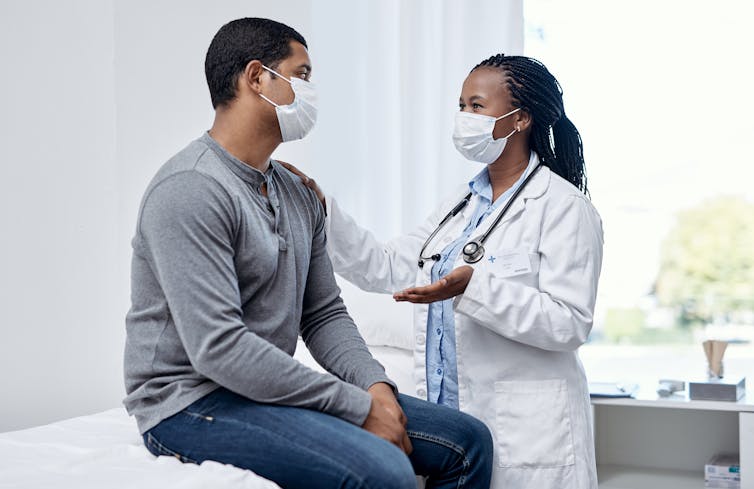
Sometimes facts and statistics aren’t enough to convince someone to get the COVID-19 vaccine. PeopleImages/E+ via Getty Images
Kathleen Mazor, UMass Chan Medical School and Kimberly Fisher, UMass Chan Medical School
Have you found yourself feeling frustrated when trying to convince a friend or family member to get vaccinated for COVID-19? Or maybe you are that friend or family member, and you’re fed up with people pushing you to get vaccinated.
Though the science is clear that COVID-19 vaccines save lives, it can be difficult to start a productive conversation about vaccination. And doctors experience the same challenge, too.
We are researchers at the UMass Chan Medical School who have been trying to address this challenge. One of us is a critical care pulmonologist who was on the front lines working in the COVID-19 intensive care unit during the darkest days of the pandemic. And one of us has studied patient perspectives on health and health care for many years. To figure out how doctors can best talk to their patients about vaccination, we first needed to understand what patients were concerned about.
In April 2020, when vaccines for COVID-19 were still undergoing testing, we asked 1,000 adults across the U.S. about their vaccination plans, and why. Around 3 in 10 were not sure whether they would get vaccinated, and 1 in 10 planned not to get vaccinated. Both groups gave a variety of reasons for their reluctance, including concerns about vaccine safety and side effects, wanting to wait for additional information, thinking they were not personally at risk, and distrust of the government, the Centers for Disease Control and Prevention, or vaccines.
We then conducted another survey in January 2021 just as the vaccine was becoming available to the public, with a new sample of about 1,700 people. Reasons for vaccine reluctance hadn’t changed since April 2020. The most common reasons were concerns about vaccine safety, speed of vaccine development and insufficient testing, as well as a general distrust of the COVID-19 vaccines.
In addition, we found that those who planned on getting vaccinated knew more about COVID-19 transmission, the potential health effects of the disease and vaccine effectiveness. They also were much more likely to rely on data and statistics when making decisions about their health than those who were hesitant about getting vaccinated.
If people who are reluctant to get vaccinated don’t rely on statistics to make health decisions, what do they rely on?
Turns out their doctor plays a big role. Several studies have shown that many people rely on their doctor’s advice in making decisions about vaccines.
We tested different approaches doctors could take to talk to their patients about the COVID-19 vaccine. While all of the messages included statements that the patient was eligible for a safe and effective vaccine, they differed by what the doctor said following this information.
We found that the most effective message was an explicit recommendation (“I recommend that you get it”) coupled with a reference to protecting others (“It’s the best way to protect the people you are close to and keep them healthy”). About 27% of those who received this message became more likely to get vaccinated.
In comparison, the least effective message was elective, or open-ended (“So what do you think?”) – only 13% were more likely to be vaccinated after receiving this message.
[The Conversation’s most important coronavirus headlines, weekly in a science newsletter]
When we followed up with people who were initially hesitant six months later, about 33% had since gotten vaccinated. Notably, of those who had a conversation with their doctor directly recommending vaccination, 52% had been vaccinated, compared to only 11% of those whose doctor had not recommended the vaccine.
Their reasons for vaccination varied. More than half cited wanting to protect others. Others expected that vaccination would be required, or were worried about getting COVID-19.

How doctors talk about vaccination with their patients can influence whether they decide to get vaccinated. Aekkarak Thongjiew/EyeEm via Getty Images
Getting at the heart of what motivates someone can be an important step in understanding their point of view. These findings may help you have more effective conversations with your family and friends – and even your own doctor.
If you are vaccinated and are seeking to encourage a friend or family member who is not:
Suggest that they talk to their doctor. The COVID-19 vaccines are becoming available in doctors’ offices, which will make it easier to get vaccinated in a familiar setting. Their doctor may also be able to provide the reassurance they need to feel good about getting the vaccine.
Talk about protecting others. Tell them how good it feels to play a role in reducing the spread of a potentially deadly disease.
Talk about protecting yourself. Tell them how freeing it is to feel safe.
If you are not vaccinated, but are wondering whether you should be:
Talk to your doctor. Tell your doctor what worries you about getting vaccinated. Your doctor has current, accurate information on the COVID-19 vaccines and can answer your questions. You may be able to get vaccinated during your visit. If not, your doctor can give you information on where to get vaccinated.
Talk to people who have been vaccinated. Many have said they were nervous or afraid to get vaccinated, but once they received their COVID-19 shot, they felt safe and relieved.
Consider how you might feel in different situations. Some people don’t mind taking chances with their own health. Others can picture what it’s like to be in a hospital for weeks or be hooked up to a ventilator, and don’t want to take that risk. And almost everyone would feel terrible if they were responsible for someone they cared about getting very sick.
Figuring out how to have a productive conversation about COVID-19 vaccines can be difficult. Looping in your doctor is one way to close the communication gap.
Kathleen Mazor, Professor of Medicine, UMass Chan Medical School and Kimberly Fisher, Associate Professor of Pulmonology, UMass Chan Medical School
This article is republished from The Conversation under a Creative Commons license. Read the original article.
In The News
>WEATHER: Mark Rosenthal's 7-day forecast (:26). High of 61 today in Worcester
-Latest on timing, rain totals and wind speeds (4:30)
-Worcester under flood watch with up to 6 inches of additional rain possible
>TOP OF THE NEWS
-Defense in murder trial to cite domestic violence, postpartum depression
-Auburn man charged after crash knocks out power to much of town
-College police chief, lieutenant placed on leave
-Amid backlash, Charlton Police Department is standing by Flock cameras
-Wolverine Grill opens its doors, giving Leicester students a restaurant of their own
-Police recover $18,000 gold necklace after robbery from Hannoush Jewelers
-Worcester O.U.I. arrest adds new case to Webster man’s decades-long criminal record
-Why does voter turnout lag in Worcester? Some say it's a self-fulfilling cycle
-Radio Worcester (13:12): Simply Delicious Catering launches $14 ready-to-heat meals in Worcester
-New express car wash debuts in Worcester
-Worcester Guardian Week in Review
>DINING OUT: Boston-based halal chicken restaurant now serving lunch in Downtown Worcester
-See the Worcester eatery people say makes some of the city's best Chinese food
-See the rest of the day's Worcester news
>HOLDEN: Vacancy on Council on Aging
-New owners to take over Sweets & Java
>THE BURBS (brought to you by North End Motor Sales): Trial of man accused of murdering cellmate in Gardner delayed
-Maple & Main honored by Shrewsbury Commission on Disabilities
-Auburn road work underway this week on 6 streets
-Uxbridge man charged with violating restraining order for friending protected party on Facebook
-2 arrested after raid of Southbridge apartment nets over 214 grams of cocaine, ecstasy, and gun
-Brimfield Auto Show returns for 18th year
-Southbridge Council sets goals, evaluation standards for town manager
-Westborough middle-school football growing in popularity
>BARS & BANDS: The Mayor's Live Music List for Sunday
>SHOWTIME: Pulse Magazine Weekend Guide (:22)
-Things to do: David Sedaris, Martian New Year party, "Snow White" ...
-Davis Mega Maze opens with new adventures and attractions (:49)
-Mass. Hidden Gems (1:21): The MIT Museum in Cambridge
>OPINION: Tanisha Sullivan: All-party primaries would bring more competition and a more vigorous democracy
-WCCA-TV's Close To Home No. 611 (28:08): Carl Rushton, Part 1
-Radio Worcester Roundtable (50:44): Union Station, Worcester’s camping proposal and the future of downtown
>OBITUARIES: Tribute to a woman who was a career special education educator
>SPORTS: Patriots-Jaguars preview: Keys to victory, prediction and more
-Patriots Mailbag: Evaluating TreVeyon Henderson, Mike Onwenu’s injury and more
-NFL Week 3 schedule, TV and announcers
-Holy Cross football takes down Lafayette, 38-30
-Holy Cross women's hockey team beats Delaware, 4-0
>NATIONAL: TikTok reaches $100 million settlement with Alabama over youth addiction claims
-OpenAI reveals more rogue A.I. incidents — attempted hacks of government, education websites
-Tragic: Girl, 4, dies after being found upside down in water-filled trash can
>NEW ENGLAND: Judge OKs Birchmore's journals as evidence in Farwell trial (1:38)
-Hollywood gripped by Lindsay Clancy murder trial with the biggest studios plotting projects
-How robot dogs and other tech change how police respond (2:50)
>COLLEGES: Unity Radio's Q.C.C. State of Mind (57:33): Enoch
-WPI gets $3.3 million to help turn industrial waste into a new source of rare earths
>TRAVEL (brought to you by Fuller RV & Rental): Omni Mount Washington Resort & Spa (4:04)
>BUSINESS: Worcester looks to boost GreenTech Park development with tax break zone
-Gov. Healey, conservative group clash over project labor agreement costs
-Features in some credit card ads are actually standard (1:58)
>HOMES: Mass. energy savings bill could emerge as October surprise
>SHOPPING: Consumer Reports warns smart appliances can expose your data (1:51)
>HEALTH: F.D.A. approves once-weekly insulin injection for type 2 diabetes
-Radio Worcester (11:33): What happens during a sleep study? Dr. Anthony Izzo explains Saint Vincent's Sleep Lab
>FOOD: McDonald’s releases limited-time menu of international fan faves
-Food & drink pairing: Loaded maked mac & cheese biscuit cup
>TV/STREAMING: How "Deadliest Catch" handled Todd Meadows' death on TV
-11 best new movies on Netflix
>MOVIES: Trailer for new Johnny Depp, Penelope Cruz movie "Day Drinker" (1:35)
>CELEBRITY: Conan O'Brien addresses uproar over drastic hair change
-Inside Richard Gere gerbil rumor
>ANIMALS: Bougie rescue pigs absolutely hate getting muddy (1:52)
>HISTORY: Allen homestead in Shrewsbury remained in the same family for nearly 300 years: The history
>GOOD NEWS: Meet the twin doctors who co-lead the E.R. of a hospital (2:33)
-Meanwhile, in Billerica, Krampus crashes Select Board meeting to support Flock cameras (3:22)
Latest obituaries | | Saturday's Highlights | | Today's horoscope | | Local Sports
Classifieds
>HELP WANTED
-Full-time police officer, town of Leicester
-Buildings and grounds laborer, Holden D.P.W.
-Interns at Unity Radio
-Bartender and server, Ground Round in Shrewsbury
See all Help Wanteds | | Job opening? Post it here for FREE today
Quick Links: Personalize your news | | Browse members | | Advertise | | Blogs | | Invite friends | | Videos
Animals | | Boston Sports | | Business | | Cars | | Celebrity | | Colleges | | Commute & Travel | | Crime | | Faith | | Food | | Good News | | Health | | Help Wanted | History | | Homes | | Local Sports | | Lottery | | Movies | | National | | New England | | Politics | | Shopping & Deals | | SHOWTIME! | | TV & Streaming | | Weather

