
Make the016.com a preferred choice with Google by clicking here 

Pope Francis has laid emphasis on protecting the environment, but he’s not the only pope to speak about caring for nature. AP Photo/Alessandra Tarantino
Joanne M. Pierce, College of the Holy Cross
Pope Francis led dozens of religious leaders Oct. 4, 2021 in issuing a plea to protect the environment, warning that “Future generations will never forgive us if we miss the opportunity to protect our common home.”
The appeal, which calls for net-zero emissions, was released after months of meetings leading up to the United Nations’ November climate conference in Glasgow, Scotland.
The pope has voiced support for green policies before, including his 2015 encyclical letter to the entire Catholic Church “On Care for Our Common Home.”
But Francis is not the first Catholic leader to emphasize care for the planet. In fact, every pope for the past half-century – except John Paul I, who died after just one month in office – has addressed environmental issues in their official publications.
As a scholar whose research focuses on the medieval Church, I see many of these concerns deeply rooted in the history of the Catholic tradition.
One of the basic beliefs of Christianity is that the material world was created directly by God, and thus fundamentally connected with God’s goodness.
This is clearly expressed in the creation narrative in the book of Genesis, part of the sacred scripture shared by Christians and Jews. As God completes each element of the world – day, night, land, sea, etc. – he sees that “it was good.” On the sixth day, when God creates human beings in God’s own image, they are given “dominion” or “rule” over everything that lives on the Earth.
Early Christians insisted that the beauty of creation reflected God’s glory. But as Christianity spread throughout the Roman Empire, they had to defend this view of the basic goodness of creation when challenged by another religious viewpoint.
This movement – called Gnosticism, from the Greek word meaning “knowledge” – taught that the physical world was created not directly by God, but by a lesser spiritual being, out of malice or ignorance. At best, the material world was a worthless distraction; at worst, an evil snare for human souls. Gnostic teachers offered to teach their followers how to free their spirits from attachment to their physical bodies and the material world. In this way, after death they could return to the realm of spiritual reality and reunite with the divine.
Many theologians and bishops criticized this interpretation of their faith. Several wrote lengthy, detailed critiques of Gnostic teaching; at stake, they believed, was the salvation of souls.
The most prominent of these was St. Irenaeus of Lyons, who lived in the second century A.D. On Oct. 7, 2021, Francis announced that he would declare Irenaeus a “Doctor of the Church,” a title reserved for saints whose writings have had a profound impact on the life of the Church.
In Irenaeus’ treatise Against the Heresies, a passionate defense of the teaching of the scriptures and apostles, he states that creation itself reveals God and God’s glory; the only higher revelation is Jesus Christ himself.
At the beginning of the Middle Ages, however, Western Christianity was left with a lingering suspicion of “worldly things,” despite this early stress on the basic goodness of material creation.

Hildegard of Bingen did it all: music, botany, medicine, drama and theology. Miniatur aus dem Rupertsberger Codex des Liber Scivias/Wikimedia Commons
By the third century, some Christians began to seek a life more fully focused on God by removing themselves from society to pray and work together in communal groups. This kind of monasticism swept across Western Europe during the medieval period.
The most influential of these monastic orders were the Benedictines, who balanced their lives between daily prayer services and work – which often involved agriculture and care of the surrounding environment. Each monk or nun pledged to remain at the same monastery for life, unless its abbot or abbess – the monk or nun in charge – ordered them to move to another. Because of this, Benedictines became known as “lovers of place.”
Today, one Benedictine saint has become especially connected with environmental concerns: St. Hildegard of Bingen, who died in A.D. 1179. This German abbess was one of the most accomplished women of the Middle Ages. An expert on herbal medicines and botany, she also wrote religious plays, composed liturgical chants and hymns, and authored theological works and poems based on her mystical experiences. She insisted that God loved the Earth as a husband loves a wife, and espoused a kind of “green” theology, called viriditas, condemning the harm that human activity could do to nature.
Hildegard has been acclaimed as an unofficial patron saint of environmentalists. In 2012, Pope Benedict XVI declared her a “Doctor of the Church,” like Irenaeus.
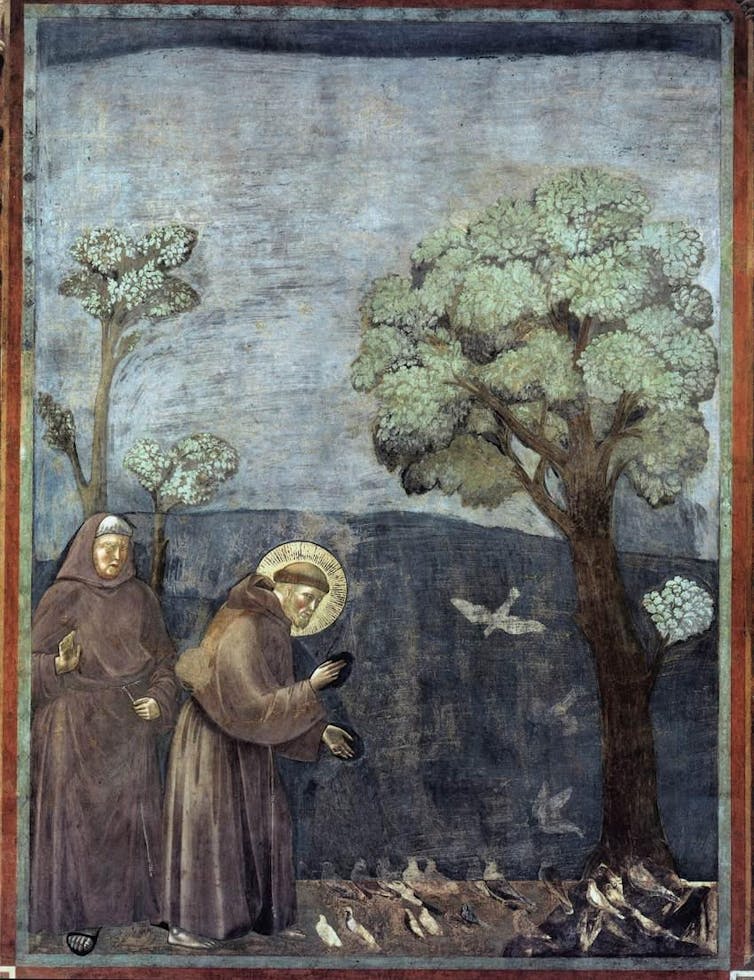
St. Francis, patron saint of animals and ecology, famously preached to the birds. Giotto di Bondone/Basilica of San Francesco d'Assisi/Wikimedia Commons
St. Francis of Assisi, son of an Italian cloth merchant, has over the centuries become renowned for his love of the natural world. After time as a soldier and prisoner of war, Francis underwent a spiritual conversion. Rejecting his father’s wealth, he chose to live a life of radical poverty and public preaching until his death in A.D. 1226. Early on, male members of his new mendicant movement, the Franciscians, took religious vows but traveled from town to town with no fixed residence, begging for food and lodging.
One of Francis’ few documents is a poem, the Canticle of the Sun, which lyrically expressed his belief in the kinship between human beings and the rest of the natural world. Even the Sun and the Moon are addressed as “brother” and “sister.” And as he lay dying, it is said that he asked to be laid on the bare Earth.
Legends about his preaching and miracles circulated widely, and some involved his concern for animals, treating them with the same dignity as human beings. One story holds that he preached to birds and convinced a vicious wolf to live in peace with nearby townspeople.
[Over 110,000 readers rely on The Conversation’s newsletter to understand the world. Sign up today.]
In 1979, Pope John Paul II named St. Francis the patron saint of ecology because he “revered nature as a wonderful gift of God.” And in 2015, Pope Francis used the first words of the Canticle of the Sun, Laudatio si’, to open his encyclical on the environment and serve as its official title.
Although often overshadowed by the notion that the material world is only a passing distraction, reverence for a creation deeply loved by God has also been an important part of Catholic tradition. Contemporary teaching on the environment is only its most recent expression.
Joanne M. Pierce, Professor Emerita of Religious Studies, College of the Holy Cross
This article is republished from The Conversation under a Creative Commons license. Read the original article.
In The News
>WEATHER: Mark Rosenthal's 7-day forecast (:37). High of 57 today in Worcester
-Peak fall foliage is getting closer (3:31)
>TOP OF THE NEWS
+6:00: State’s first cannabis lounge in Worcester to close, owner seeks new location and state license
+6:00: Worcester area voters head to polls for early voting
+6:00: Worcester councilor seeks community forum on Amazon drones
+6:00: Wachusett senior undergoes revolutionary spinal procedure to play football (3:07)
+6:00: Worcester hockey alumni 2026-27 highlights, NHL Week 3
-The "Mystery of the Stained Glass Window" continues to confound
-WPI research using A.I. to identify melanoma gets boost in international competition
-Bee Zee seeks approval for Southwest Cutoff gas station expansion
-Prosecution rests in Inoa retrial; alleged accomplice doesn’t testify
-Worcester's 10 biggest development opportunities
-Mayor Petty wants City Council to take stance on marijuana law
-Amazon drone deliveries, marijuana ballot question and street repairs on Worcester council agenda
-Shrewsbury calls for pause on Amazon drone delivery amid concerns
-Coat drive to distribute nearly 4,000 winter coats
-From public housing to homeownership in Worcester: Worcester Housing Authority programs changing narrative around affordable (2:36). Article
-Nativity School opens applications for upcoming year
-Community Media Day on Tuesday
-Mount Wachusett has been a popular Central Mass. destination for 150 years
>DINING OUT: Worcester restaurant celebrates 1 year on Park Ave.
-Multi-cuisine food hall Wonder opens in Worcester. How to get 50% off
-ICYMI: "Back to spending time together": The world of mahjong proves popular in Central Mass.
-A boy who struggled to be heard finds his voice—and a championship—in the waves
-Worcester addiction forum emphasizes housing, employment and support beyond treatment
-1 Worcester home’s power bill is $500. A half-mile away in Shrewsbury, it’s 70% lower
-Worcester man charged in $162,180 Mass. Health fraud
-See the rest of the day's Worcester news
>HOLDEN: Halloween trick-or-treating 5 to 8
-Halloween in Holden next Saturday
>THE BURBS (brought to you by North End Motor Sales): Leominster schools tout massive improvement in state assessment
-Data centers, Flock cameras among key votes at Charlton Special Town Meeting
-Dudley man arrested after police execute warrants, seize stolen guns and drugs
-Harvard Sweet Boutique owner shares affection for confections with community
-Free overdose response training Tuesday in Shrewsbury
-Southbridge fire station nearing completion as $20 million project remains under budget
-Westborough Women's Club raises funds to help those battling childhood cancer
>BARS & BANDS: The Mayor's Live Music List for Monday
-Mass. bars can stay open an extra hour this Halloween. Here's why
>SHOWTIME: Wholesale Klezmer Band brings "Jewish Life in Song" to Southbridge
-100 FM The Pike (16:11): Steve Schirripa ("The Sopranos," "Blue Bloods") is bringing Willie Boy to Worcester
-Radio Worcester (16:17): Joel Hoekstra on Trans-Siberian Orchestra’s Worcester return
>OPINION: Scotia Hille: Omnibus bills enable opaque lawmaking
-Jay Kaufman: Complexity isn’t the issue. The Legislature’s dysfunction is
-WCCA-TV's Close To Home No. 612 (28:24): Carl Rushton, Part 2
-Radio Worcester's The Rundown (26:00): Journalists' superpower and Worcester media in 2026
-Radio Worcester Roundtable (47:05): Ballot questions 1, 2 and 3, plus changing local media landscape
>OBITUARIES: Tribute to longtime Worcester priest
>SPORTS: Patriots beat Jets, 26-19, as Drake Maye throws 3 touchdowns
-Patriots once again battered by injuries in win
-New era begins as Jayson Tatum, Celtics embark on first season without Jaylen Brown
-Holy Cross men's ice hockey downed by Army
-CBS Sports Network to air Holy Cross at Lafayette men's basketball matchup
-Railers lose to Trois-Rivieres, 5-2
-Gov. Healey calls for girls flag football to become official M.I.A.A. varsity sport
>CARS: Tesla’s new flying Roadster performs stunning maneuvers during live unveiling
>NATIONAL: Deadly incident at Canada military base
-French police arrest 1,800 protesters after violent clashes and looting
-Air Force commando dies after falling from 170-foot rafters during fast-rope demonstration at college football game
-Tragic: Father of 3 stabbed to death while getting snacks for kids waiting at park
>NEW ENGLAND: What's ahead this week in the Matthew Farwell trial (2:52)
-After suspended drunken crash, Mass. candidate for lt. gov. suspends campaign (2:31)
-Ballot question 7: Could smaller lots make homes affordable? (2:27)
>COLLEGES: Leah Ben-Ami named executive director for Foundations Forward at Assumption
>TRAVEL (brought to you by Fuller RV & Rental): Not declaring this item at customs can get you a $300 fine
>BUSINESS: Central Mass. business by the numbers
-The best and worst months to apply for a job, according to data
-Q&A: Good Feels grows amid cannabis industry uncertainty
>SHOPPING: Don't pay full price for fall and Halloween decor at these 6 stores
>HOMES: Real estate Q&A with Kathleen Goneau
>HEALTH: Why you may have trouble finding new flu shot at pharmacies (2:27)
-Tapeworm drug could treat disease that affects 190 million women
>FOOD: Daily Dish: Simple lemon chicken
>TV/STREAMING: Trailer for new 4-part Netflix docuseries on Mike Tyson (2:28)
>MOVIES: Family friendly Halloween movies
>CELEBRITY: Viola Davis reveals disease that left her with "9 out of 10" pain
-Elizabeth Hurley sparks engagement rumors with mysterious new diamond ring
>ANIMALS: Cat family shows up just as family says goodbye to their dog (1:59)
>HISTORY: A new book reveals the sickening extent of J.F.K.'s philandering
>GOOD NEWS: Man becomes oldest to fly with wingsuit, attempts to break record
-Meanwhile, in Las Vegas, man accused of stealing flamingo says he drank up to 40 beers before pulling off heist
Latest obituaries | | Sunday's Highlights | | Today's horoscope | | Local Sports
Classifieds
>HELP WANTED
+Bartenders, Grafton Street restaurant
-Line cooks, kitchen help, Shrewsbury Street restaurant
-Snow plow contractors, town of Shrewsbury
-Full-time police officer, Paxton Police Department
See all Help Wanteds | | Job opening? Post it here for FREE today
Quick Links: Personalize your news | | Browse members | | Advertise | | Blogs | | Invite friends | | Videos
Animals | | Boston Sports | | Business | | Cars | | Celebrity | | Colleges | | Commute & Travel | | Crime | | Faith | | Food | | Good News | | Health | | Help Wanted | History | | Homes | | Local Sports | | Lottery | | Movies | | National | | New England | | Politics | | Shopping & Deals | | SHOWTIME! | | TV & Streaming | | Weather


